Photo Story · Kumar Nigam
When Builders Meet Invaders
A nest war, one morning at a single tree, and the fieldcraft behind the frame
The photograph is the last one percent
Everything before the shutter — knowing the bird, reading the light, fieldcraft, ethics, and the long patient wait — is the ninety-nine percent. The click is the one percent. Almost everything in this story lives in that ninety-nine.
Part One — One Tree, One Morning
A nest war between a Black-rumped Flameback and a pair of Brahminy Starlings, held from beginning to end.
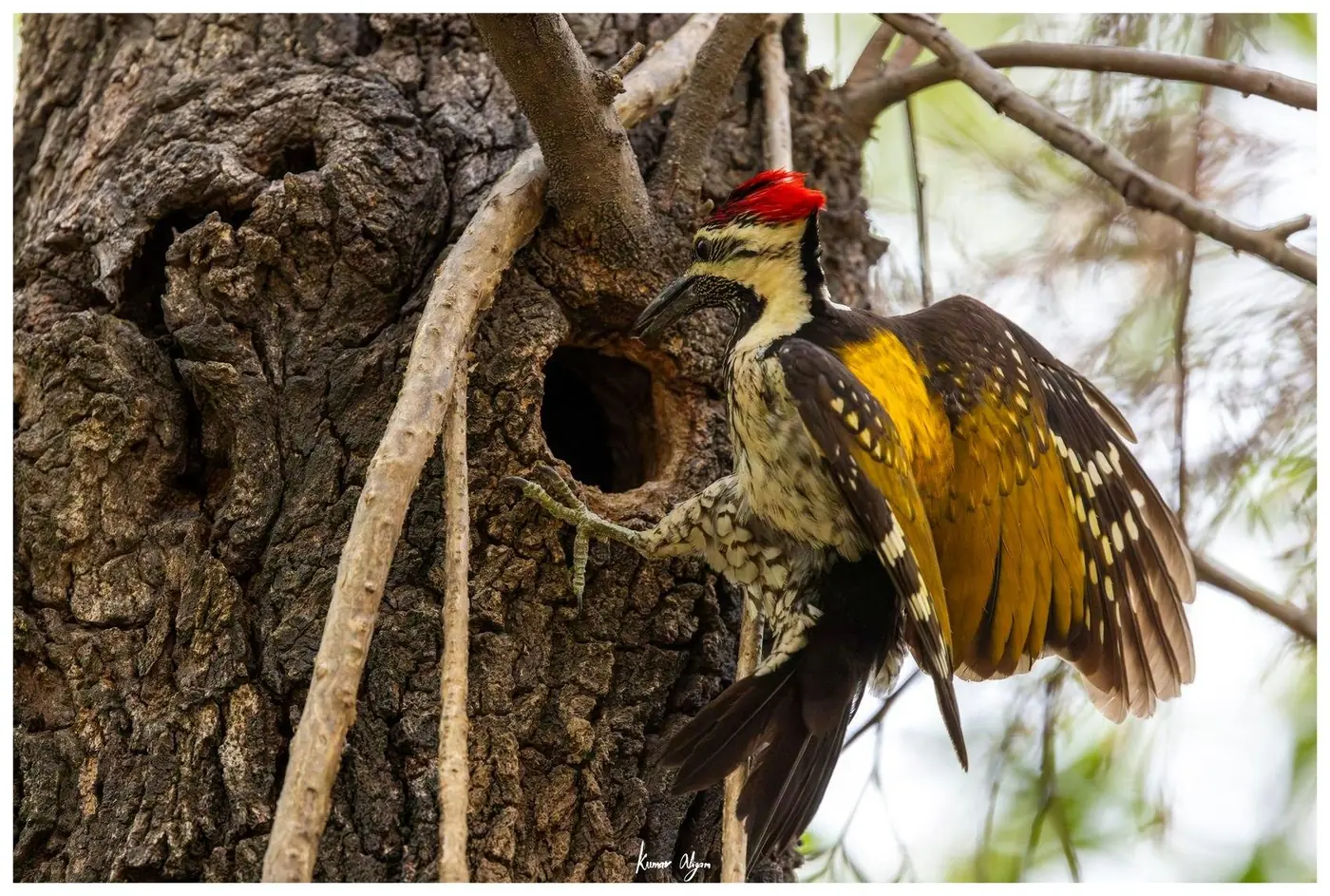
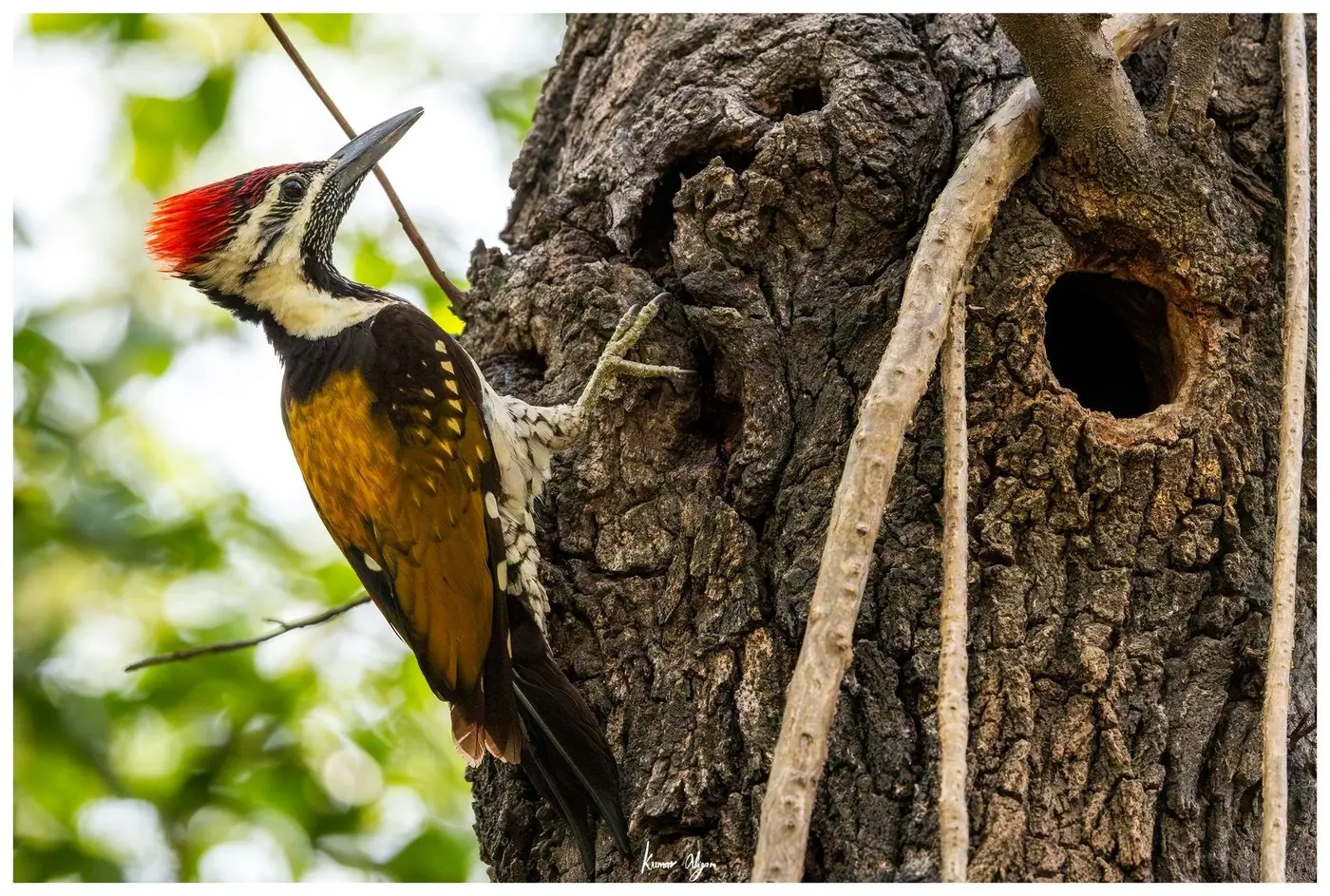 A Black-rumped Flameback beside the doorway it carved. Days of work, and the
whole hope of the season.
A Black-rumped Flameback beside the doorway it carved. Days of work, and the
whole hope of the season.
The builder
A woodpecker does not move into a home. It makes one.
Our main character is a Black-rumped Flameback, the golden-backed woodpecker with the scarlet crest and the loud, laughing call most of us in India hear long before we ever see the bird.
While most birds gather grass and twigs and build outward, the Flameback does the opposite. It chooses a strong tree, then it digs. For several days this male had been carving, using its bill like a chisel and its stiff tail as a brace, until a clean round doorway appeared with a deep chamber behind it.
To a passing eye, only a hole. To the bird that made it: days of labour, and the whole hope of the season.
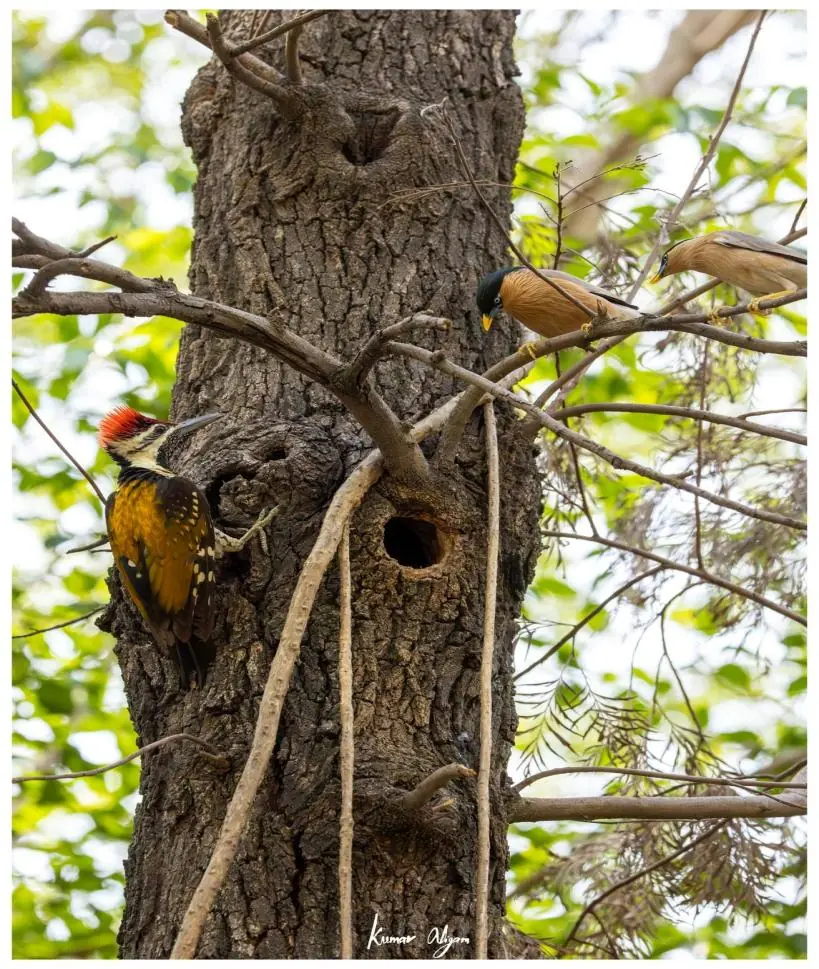 Not curiosity. They were learning his routine, and waiting for the gap in it.
Someone was watching
A pair of Brahminy Starlings had begun to visit the tree — soft, sandy birds with a little black crest they raise when excited, which this morning was nearly all the time.
They were not there to dig. Starlings cannot excavate. They are secondary cavity nesters: they wait for somebody else to do the hard part, then look for a way to move in.
So they settled on a nearby branch and studied him — when he entered, when he left, how far the door was from their perch.
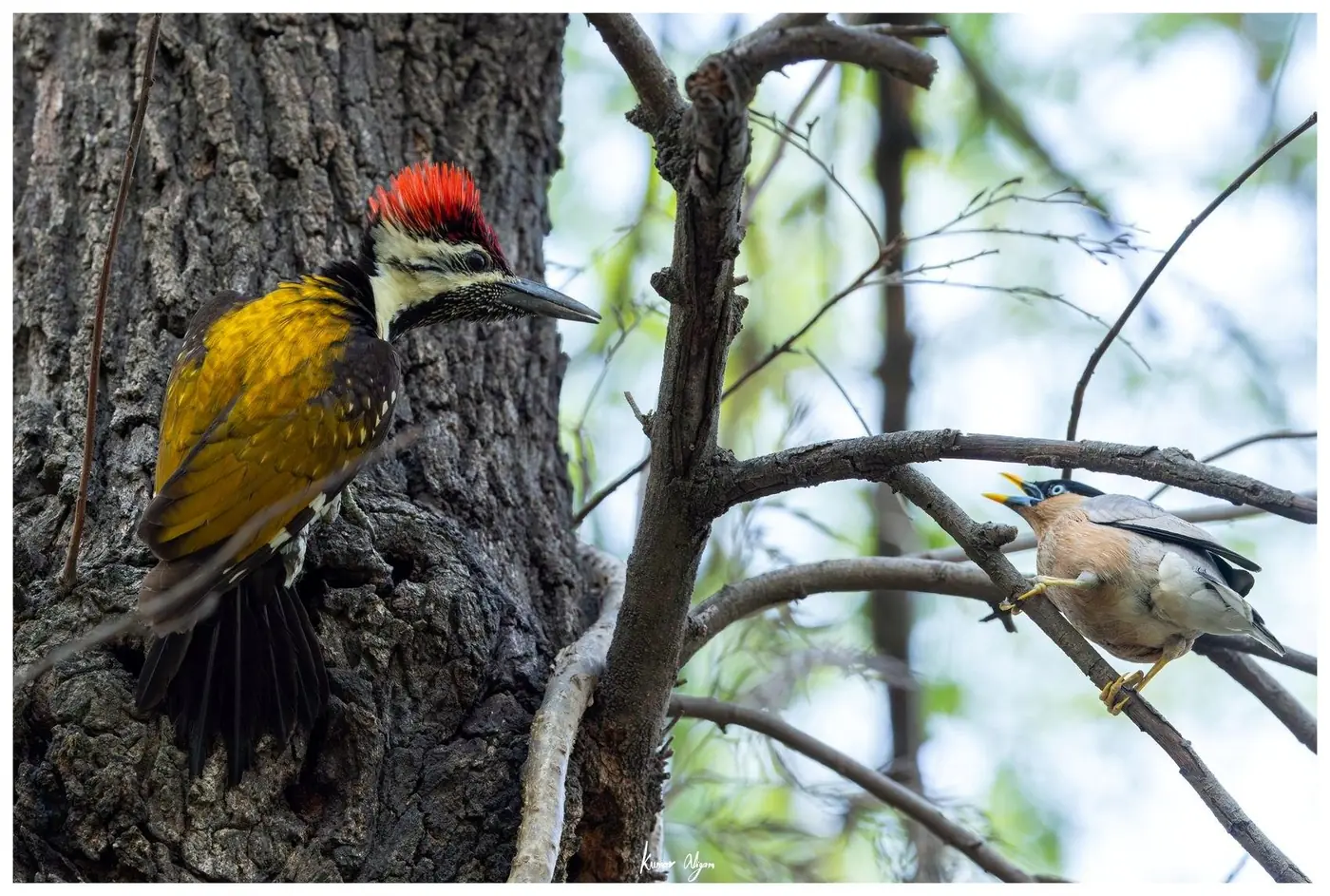
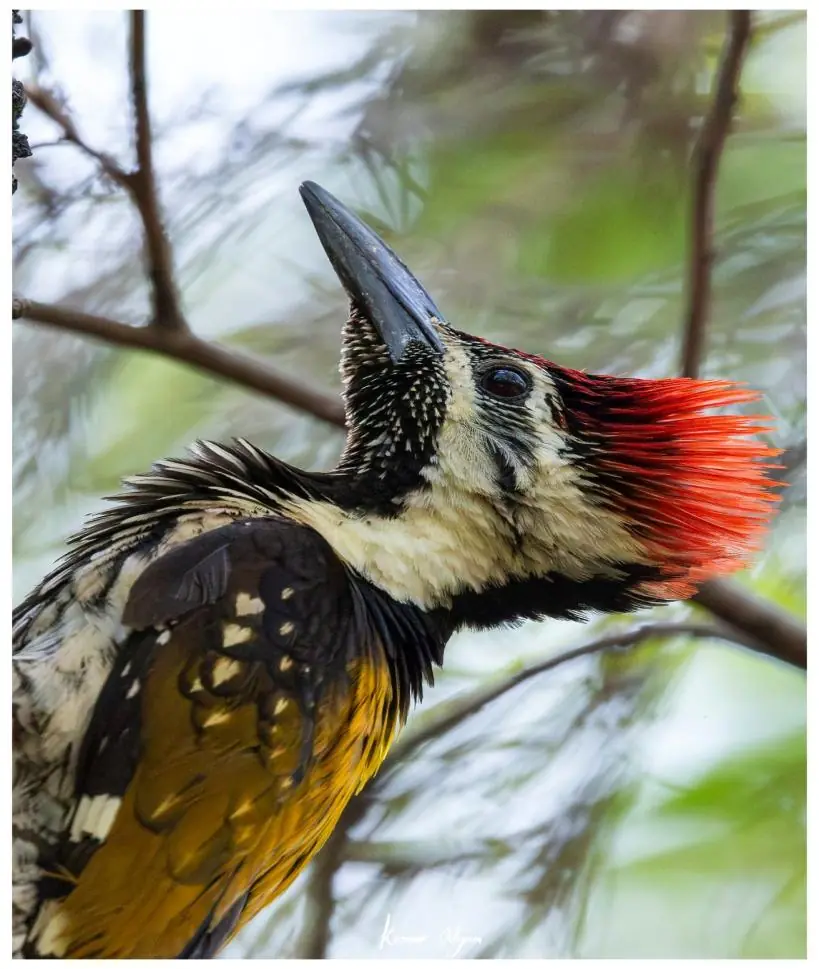
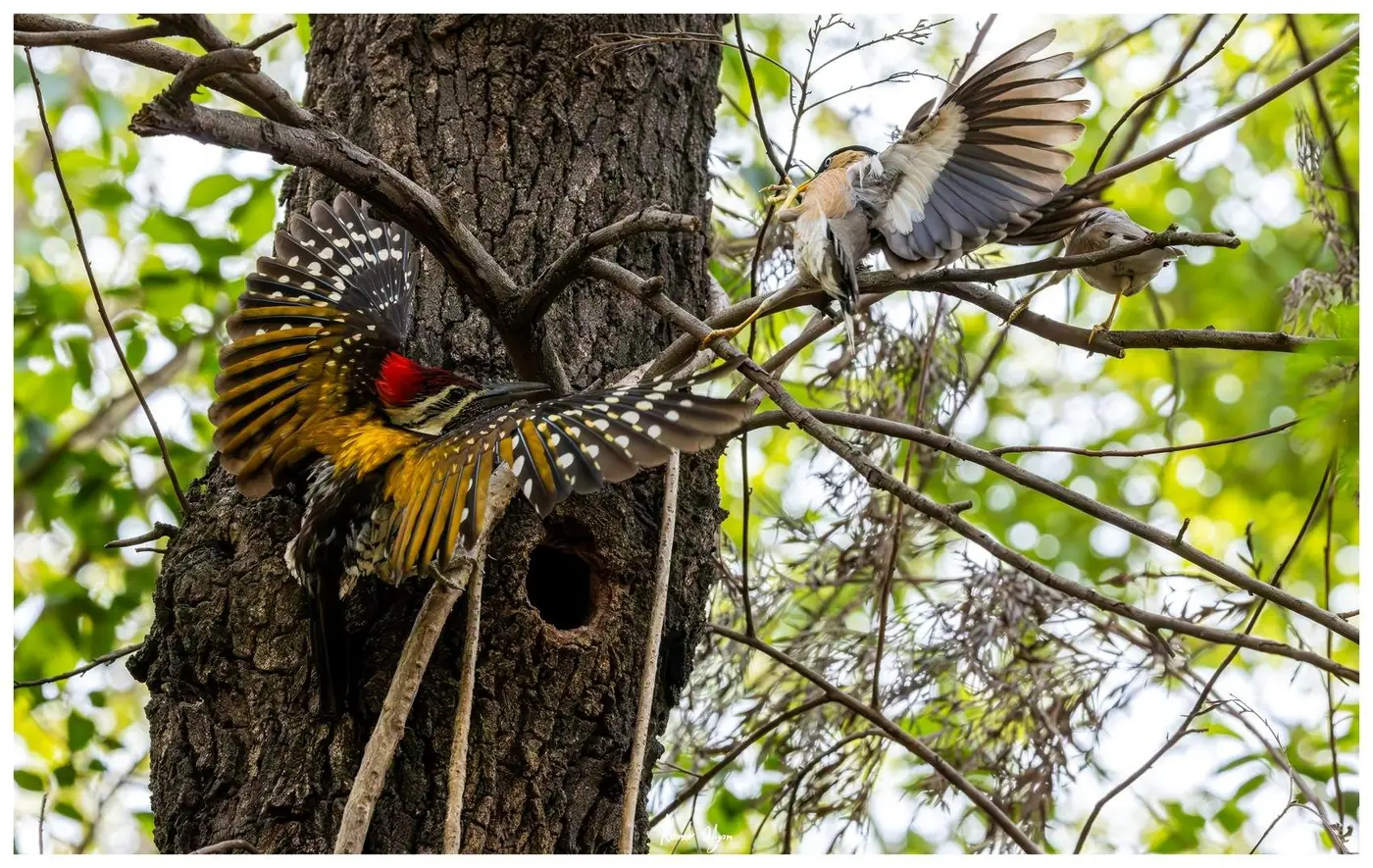 "This address is taken." Wings spread and crest raised, the owner makes himself
large — a warning, not a bluff.
"This address is taken." Wings spread and crest raised, the owner makes himself
large — a warning, not a bluff.
Strength versus persistence
The starlings did not meet strength with strength. They leaned on the one advantage they had: numbers and patience. One would draw the owner to the right; the other quietly shifted left. Every time he turned to face one threat, the second crept closer to the door.
This went on for hours — the woodpecker guarding every angle, the starlings circling back, calling, switching branches, feeling for the one mistake they were sure he would make.
In the wild, the win does not always go to the strongest body in the fight. Often it goes to whoever is willing to stay the longest.
Two strategies, side by side
| Black-rumped Flameback — the builder | Brahminy Starling — the house-hunter |
|---|---|
| Carves its own nesting cavity | Cannot excavate a cavity of its own |
| Invests several days building the nest | Searches for cavities that already exist |
| Defends the entrance with displays and lunges | Relies on persistence and repeated pressure |
| Has the greater size and physical strength | Has numbers, timing and patience |
| Risks losing weeks of effort in a moment | Risks finding no nesting site at all |
Neither strategy is wrong. They are two honest answers to the same hard problem: a safe place to raise a family.
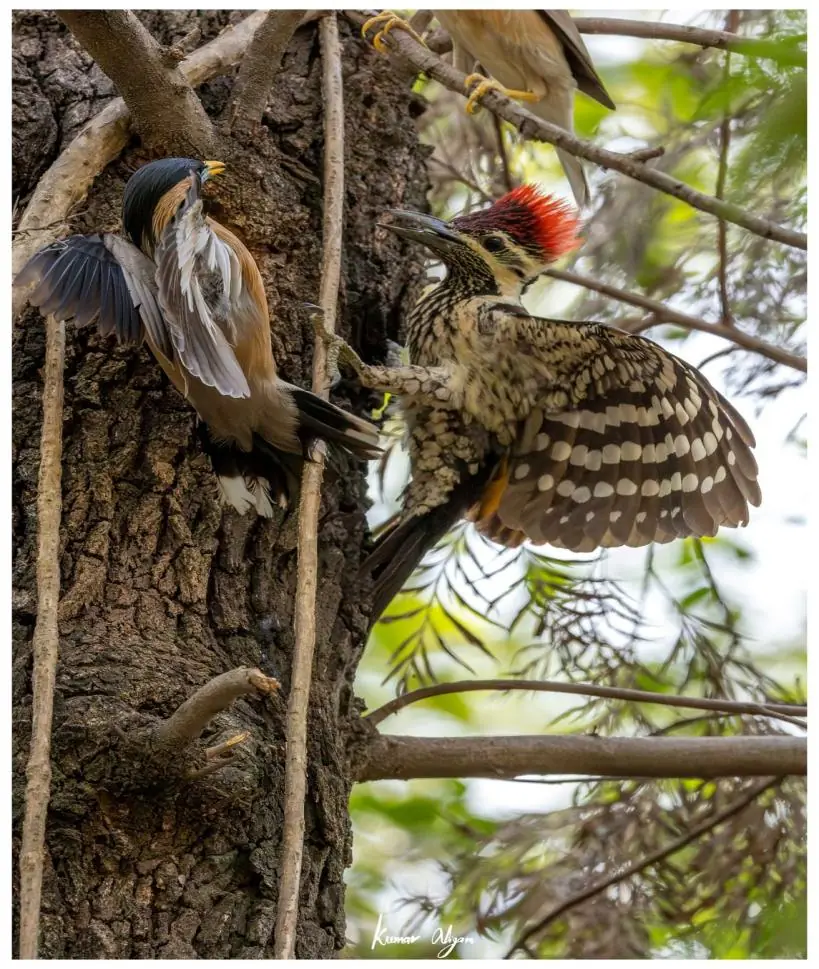
A whole morning folds into a few seconds
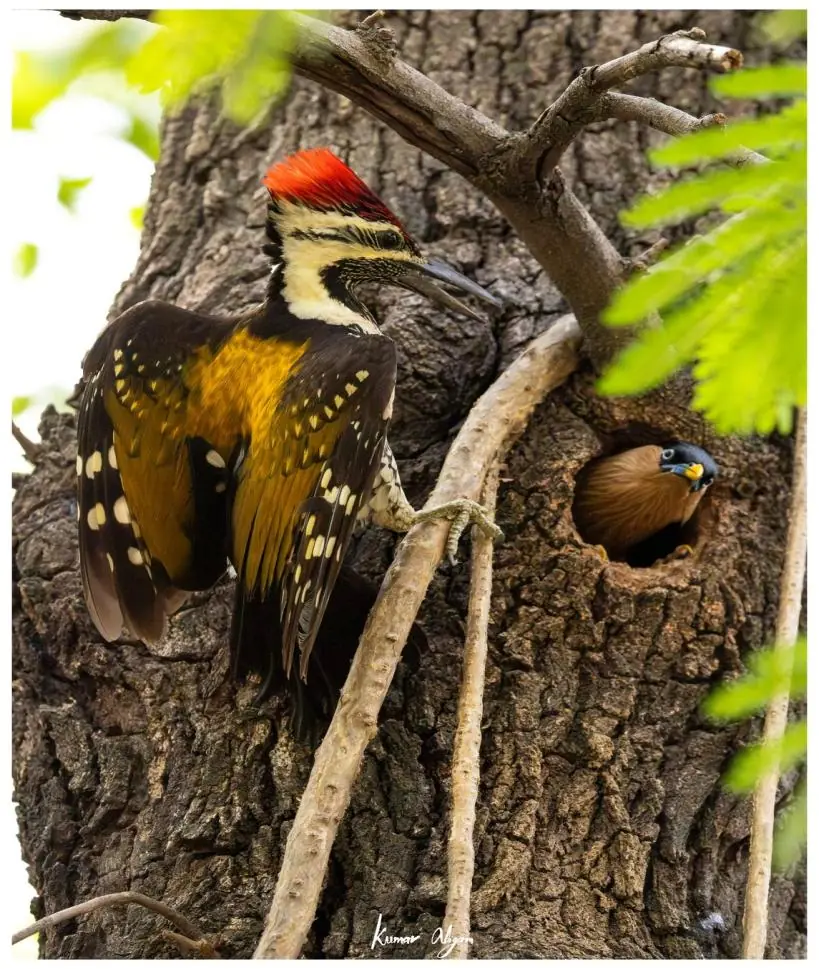
Then, after all those hours, the mistake arrived. The Flameback left the doorway — only for a moment, the kind of short absence that had happened a hundred times already.
This time the starlings were ready. The instant he was clear, one broke for the cavity while the other held station as a lookout. Everything that had looked like scattered harassment suddenly made sense. It had not been random. It had been a plan, rehearsed all morning.
One starling vanished inside the chamber he had spent days building. He rushed back almost at once, but he was a beat too late — and a beat was all it took.
A silent tragedy
Beneath the tree, one of the Flameback's eggs had been broken, the shell scattered across the soil.
I want to be honest about what a photograph can and cannot tell you. I cannot say whether the egg was destroyed on purpose, to clear a rival brood, or broken by accident in the struggle inside that narrow space. Both are recorded among birds that compete for cavities. From where I stood, I could only photograph the result.
What was not in doubt was the loss: days of work, and one egg of the next generation, gone in about the time it takes to say this sentence.
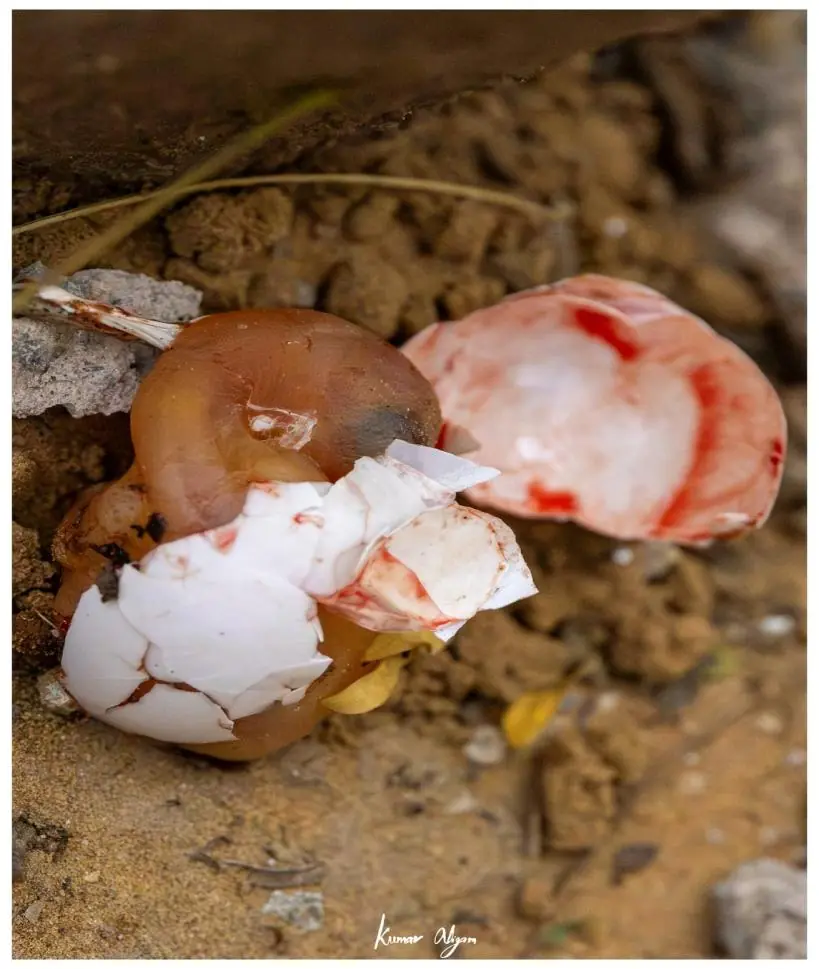 The cost, lying on the ground.
Nature has no villains
It would be easy to leave the starling cast as the villain. Standing there with the broken shell in my frame, I felt that pull myself.
But the wild deals in no villains. The starling was not cruel — it was securing a safe place for its own eggs, in a season when one good cavity can decide whether chicks live or die. The woodpecker was not aggressive for its own sake — it was defending days of work and the family it had prepared for.
Both were doing exactly what millions of years had shaped them to do. On this morning, at this tree, two honest instincts simply could not both win.
Why this matters
A hole in an old tree is rarely just a hole. One doorway, carved once, can house a whole run of neighbours across the years:
This year the woodpecker carves it → next year a starling moves in → the year after an owl takes it on → in seasons to come a squirrel, wild bees, a small reptile.
Lose the old trees, and all of that quiet housing comes down with them. We do not just lose a tree. We lose the homes of everyone who was ever going to live inside it.
Behind the lens
This behaviour did not arrive in one dramatic instant. It came together slowly, across several hours of standing still and watching.
Early that morning I made a decision: not to chase one clean portrait and leave, but to hold the whole thread — the digging, the defending, the long siege, and the loss at the end. Sequences like this are rarely seen from beginning to end, and rarer still to record in full.
Ten minutes at the hole gives you a portrait. A whole morning gives you a story. The difference is almost always just patience.
Part Two — The Architect
The Baya Weaver, and the finest craftsman in the forest
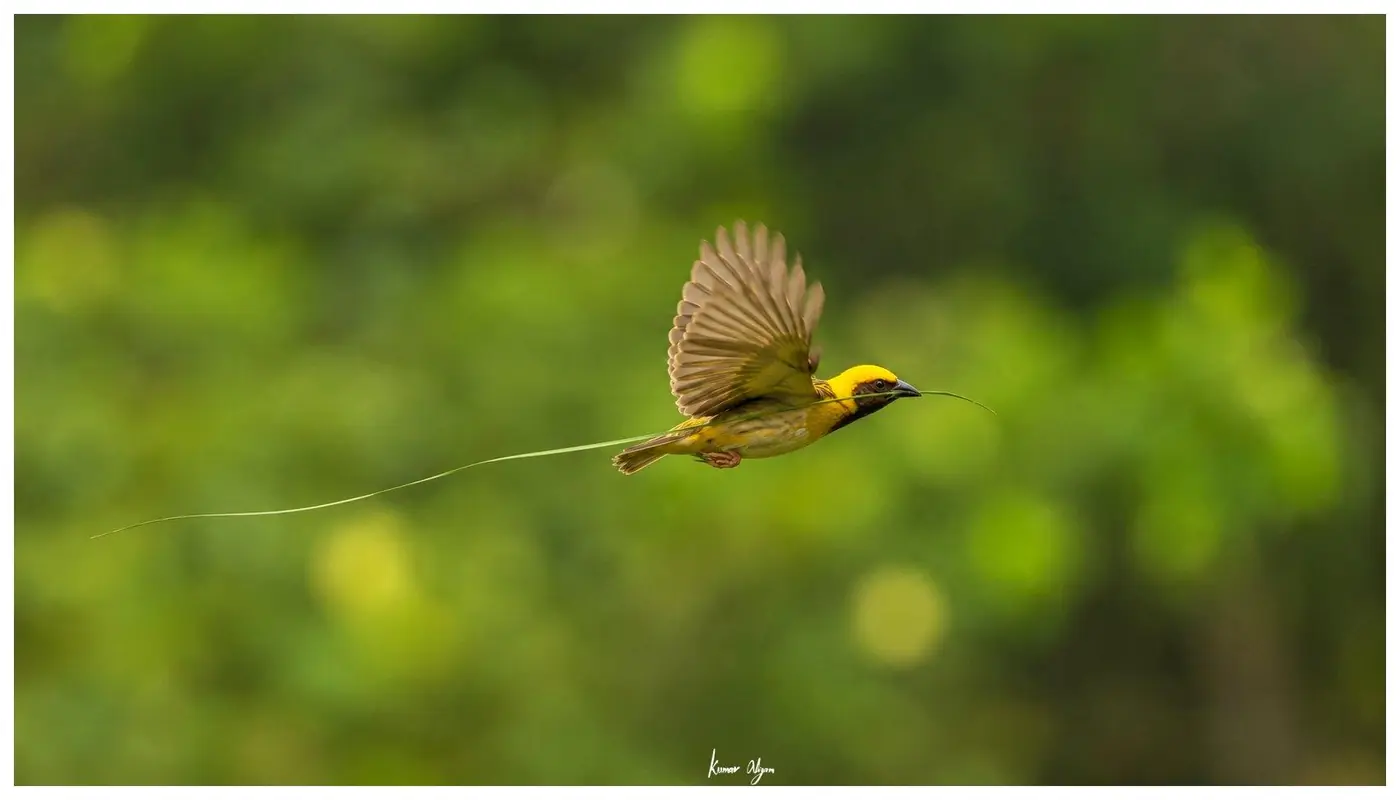 A thousand journeys, one blade at a time.
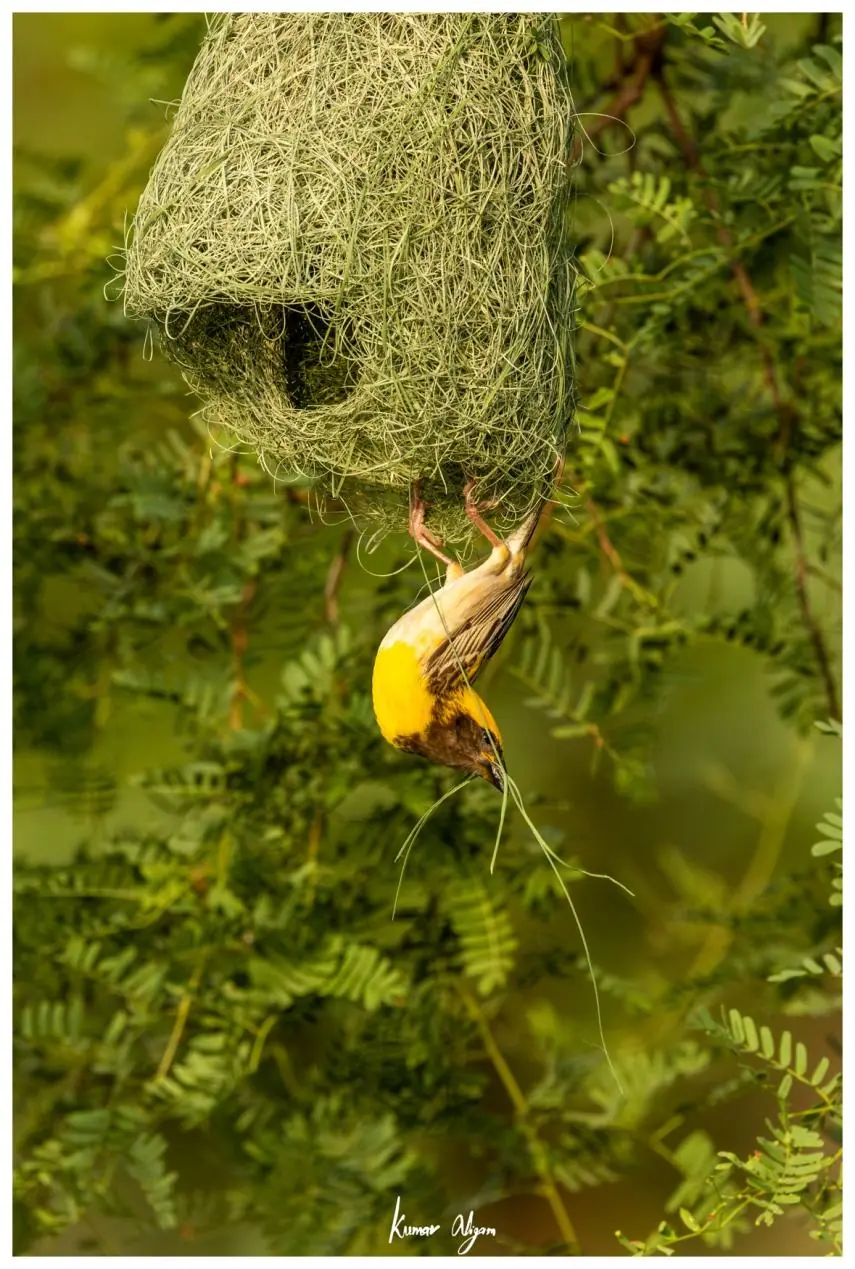 The knot no one taught him — woven by beak and foot, upside down, into a
waterproof retort of grass with the entrance below.
The knot no one taught him — woven by beak and foot, upside down, into a
waterproof retort of grass with the entrance below.
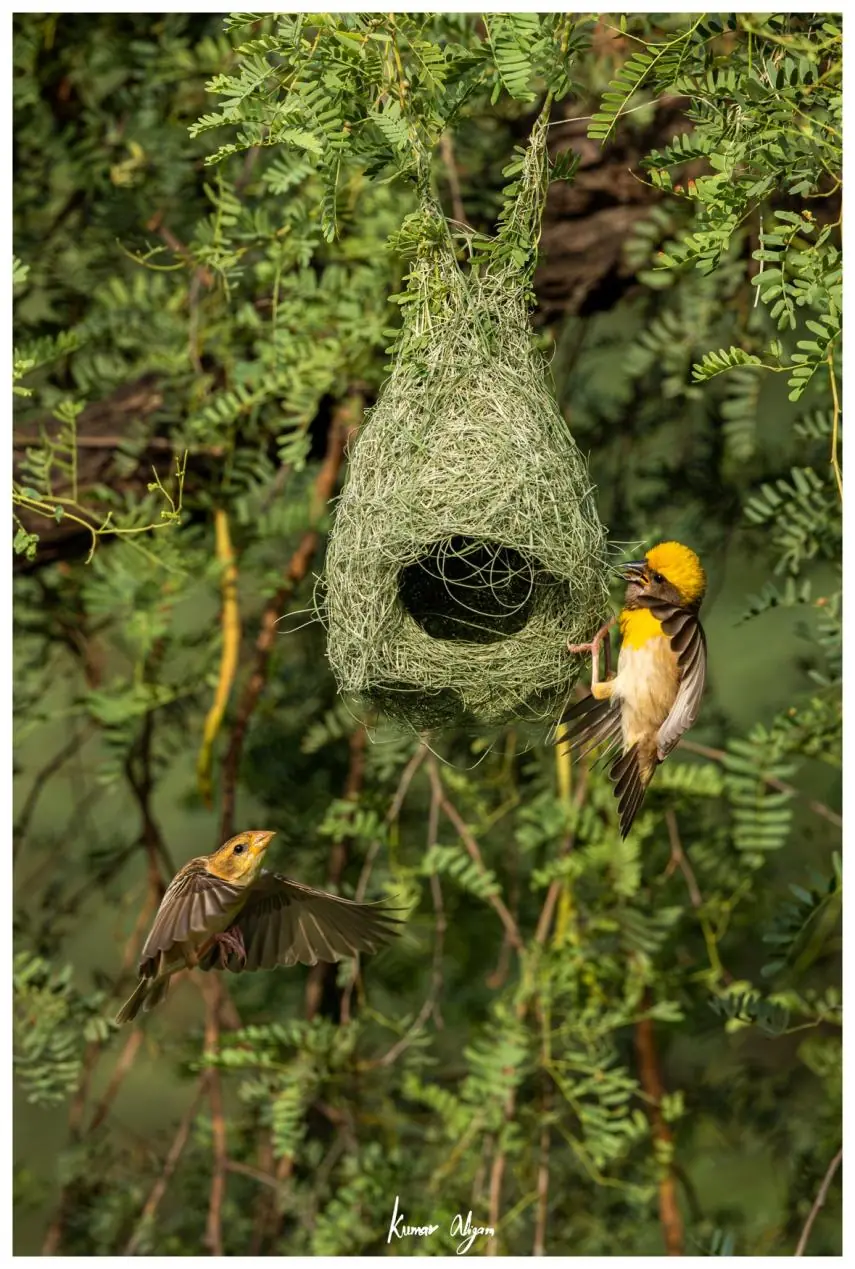 She inspects. She decides. He builds only to the halfway stage, then displays and
waits. The half-built nest is his resume, and her choice is the whole reason he
weaves.
She inspects. She decides. He builds only to the halfway stage, then displays and
waits. The half-built nest is his resume, and her choice is the whole reason he
weaves.
Part Three — The Same Patience, After Dark
The identical discipline of the tree, now pointed straight up, at a subject that moves even more slowly than a nesting bird.
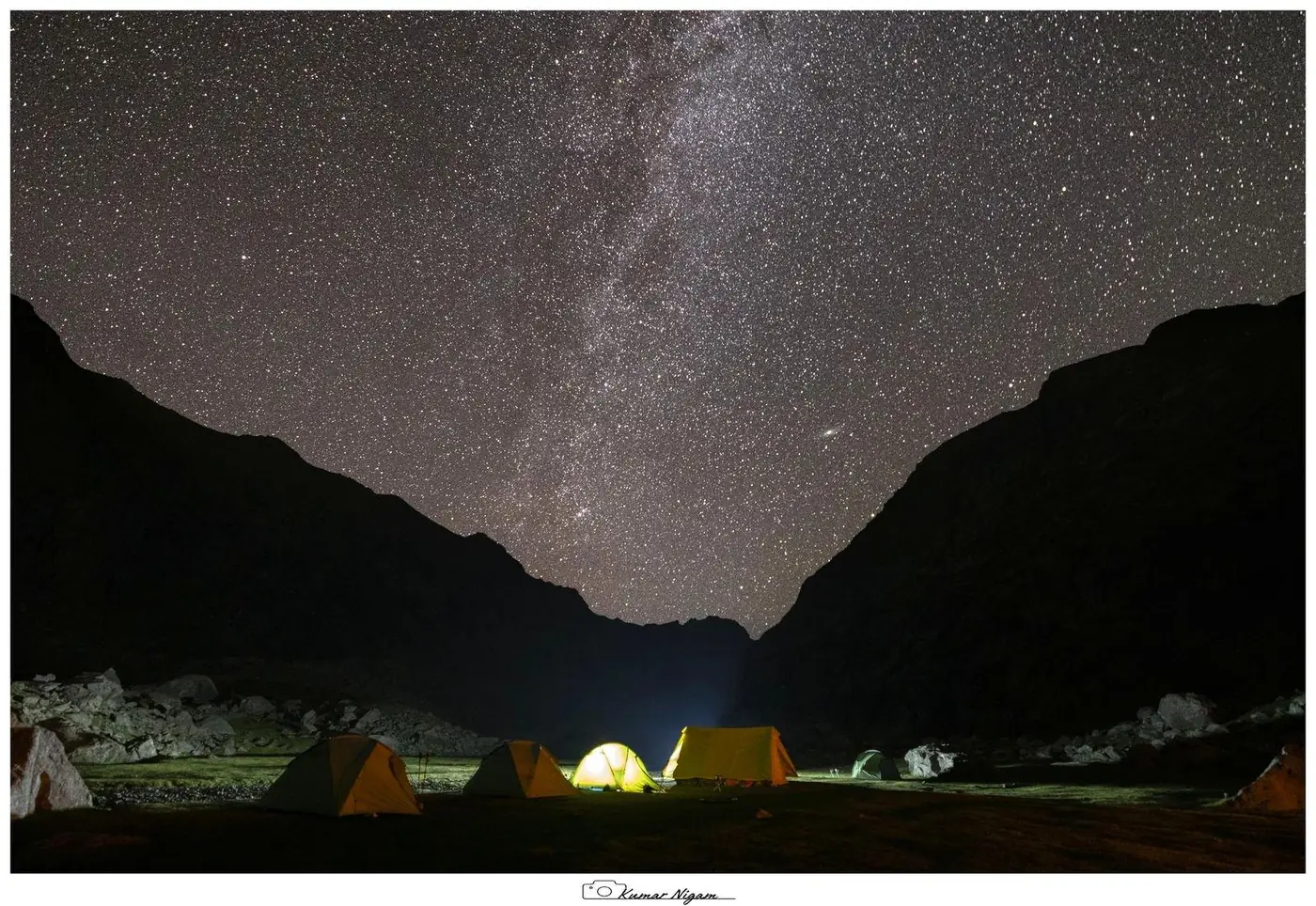 Freeze the sky. On a moonless night, keep each frame short so stars stay as
points. Our neighbouring galaxy, Andromeda, is visible in this frame.
Freeze the sky. On a moonless night, keep each frame short so stars stay as
points. Our neighbouring galaxy, Andromeda, is visible in this frame.
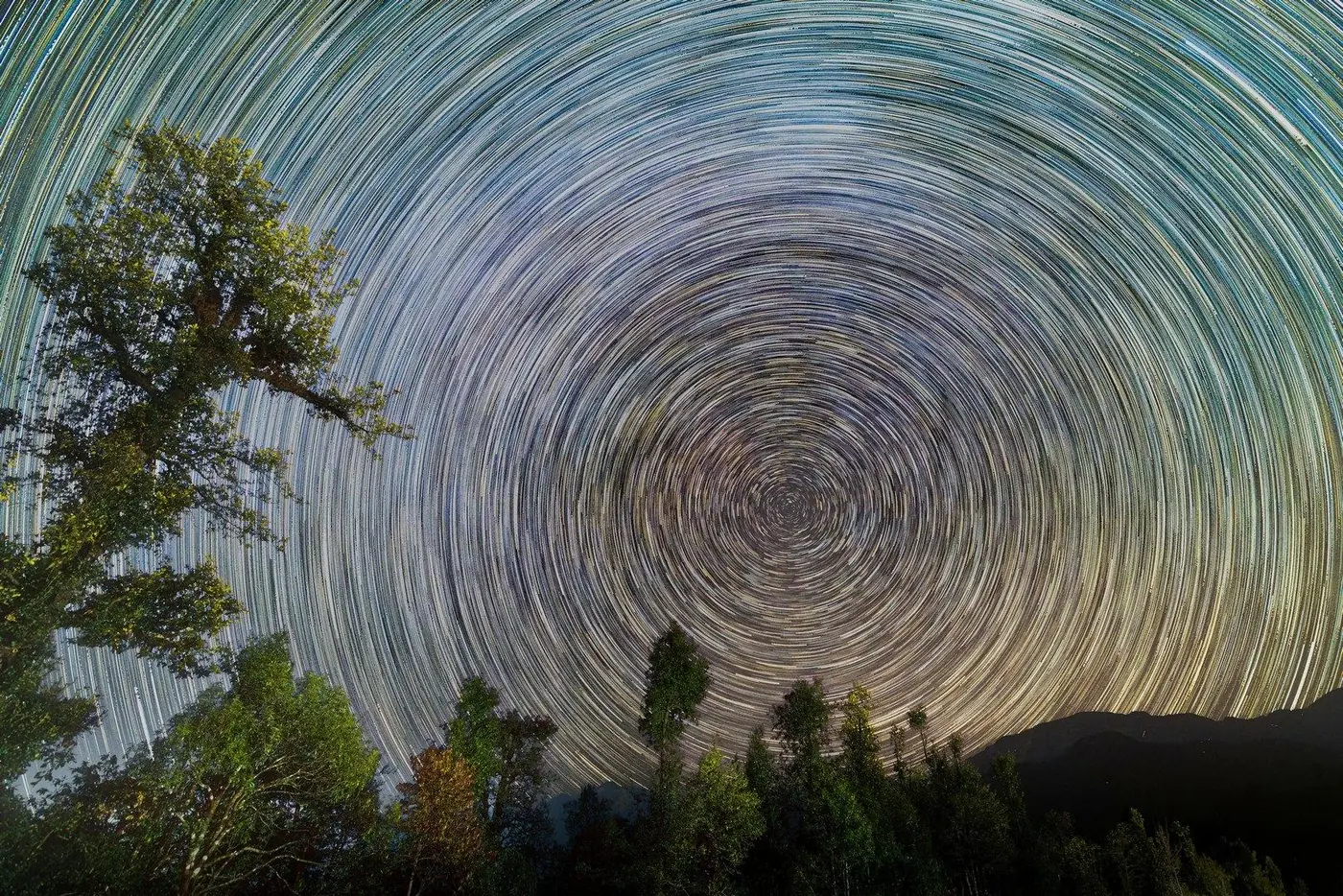 Or let it spin. Hours of thirty-second frames stacked into arcs. Every circle
turns on one still point — Polaris, the star above the Earth's axis.
Or let it spin. Hours of thirty-second frames stacked into arcs. Every circle
turns on one still point — Polaris, the star above the Earth's axis.
The thread
The nest war became a story only because I held one tree for a whole morning, and recorded the loss as honestly as the drama. The night sky gives up the Milky Way, or a full circle of trails, only to someone willing to sit out in the cold for hours. Different subjects, the same discipline.
The photograph is the last one percent. The other ninety-nine is a way of being in nature — and that is the part I love the most.
Photographs and text © Kumar Nigam. Published on WPCI with the photographer's permission. All rights reserved.